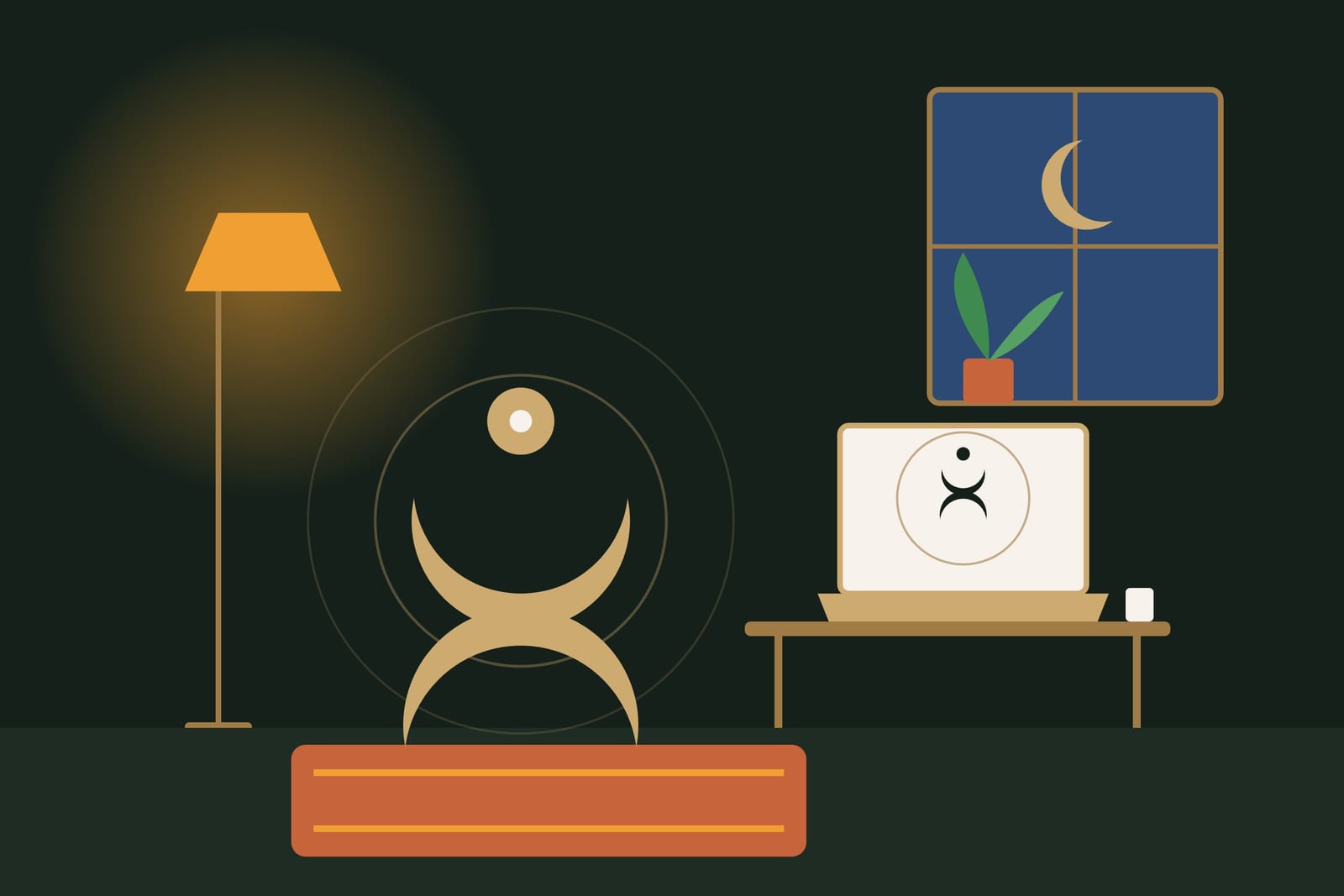
Yes. Embodiment coaching works online, and for some people it works better than in a room with me. You need a space where nobody walks in, enough floor to stand up and take a step, and a camera. The rest is the same as in person: we talk, we notice what your body is doing, and we try something different.
"But isn't the whole point that you see my body?"
This is a fair question. Embodiment coaching works with posture, breath, gesture and movement, so it sounds as if I'd need to be next to you.
I don't, for one simple reason: embodiment is about your body and what you feel on the inside, not how someone from the outside looks at it. My job is to ask the right question at the right moment ("What just happened in your shoulders?"), to point out what I see if you want me to, and to suggest trying something. All of that works through a screen. What I can't do online is touch. But most of the work we do doesn't require that.
Your own life is right there
When you come to a studio, you leave your life at the door. That can make the work a bit theoretical. We talk about the kitchen where you answer work messages at eleven at night, or the chair you sit in during difficult family calls, and you have to imagine them.
How you are in your body isn't fixed. It changes with the place you're in and the people around you. Habits often are tied to certain surroundings. Doing a session online can have the advantage that you are right there. In the space where the patterns show up. You don't need to imagine being there and this can make it easier to find a more practical way of sitting, standing or moving differently. Nothing has to be carried home, because you're already home.
For a lot of people home also feels safer than a stranger's room. When you feel safe you notice more, and noticing is most of the work.
The camera can become part of it
Some people are very aware of being watched. Usually in a video call you see yourself in a little window, this can be switched off. Still the awareness that we are seen changes something in our behaviour. In a video call we have the option to switch off the camera. This might give you the chance to notice what changes in you when you know that you are not seen.
What changed in your breath? Did your shoulders drop? Did you say something you wouldn't have said with the camera on?
Being seen by others shapes how we hold ourselves more than most of us realise. For people who perform a lot, at work or at home, this can be a very interesting realisation. Camera on or off is fully your choice, just like anything else we do in a session.
What is harder online
Of course some of the aspects of human interaction are lost online. Small changes in body and movement for example. In a room we can stand face to face, feel each other, notice what happens when one of us comes a step closer. Eye contact is different because we look at the screen and not directly into each other's eyes.
It can also be harder to arrive. You might come from another online meeting where you used your brain and suddenly I ask you to feel your body. So we start slowly, with a few minutes of centring, for example with noticing your feet and your breath, finding your balance, softening a little. We don't rush into the topic.
And then there are the ordinary interruptions. The internet connection might freeze, the doorbell rings or a flatmate comes.
What you need at home
Very little:
- a room where you won't be interrupted
- enough space to stand up, take a step or move a little
- a camera placed so I can see more than your face
- headphones if you share your home
- comfortable clothes, water, and a notebook if you like to write things down
No mat, no special clothes, no experience.
How an online session runs
The same way as in person. You bring what's on your mind and we talk. We centre for a moment. While you talk I ask what you're doing in your body, and then I might invite you to move or change something.
At the end you leave with something small to practise during the week. I've described this step by step in What is embodiment coaching?
Questions people ask
Do I have to be on camera the whole time?
Mostly, yes, if you are comfortable, so I can see how you sit and move.
I live with other people. Will it still work?
Yes, if you can have one room to yourself for the hour. Headphones mean nobody hears my side of the conversation.
Will I have to move a lot?
No. Most of it is small: sitting differently or moving a little. Nobody has to look good doing it.
Which time zones do you work with?
I'm in India (IST). Mornings in Europe and afternoons in Southeast Asia usually work well. Write to me and we'll find a time.
In which language?
English or German.
Book an online session
If you're wondering whether this would work for you through a screen, one session is the simplest way to find out. Write to me and we'll find a time.
Barbara · yoga teacher, embodiment coach and Tao Tantric Arts facilitator

Thank you. Your comment is waiting for Barbara’s approval.
Thank you. Your comment is published and will appear here shortly.
Your comment was not sent. Check the fields and try again.
Comments are closed for this post.